
Understanding Demodex in Boxers
This page was researched and written by Margie McMillan to help puppy buyers and owners better understand demodex, a condition that is far more common than many people realize. Images used here were sourced from Google Images, with credit given to the original creators of the referenced YouTube videos. If you find portions of this page reproduced on other breeders' sites, they may have been altered without permission, so please be mindful of the honesty of other sources. Any reuse of this content requires my permission.
This information is offered for those who are unfamiliar with demodex, so you can gain a clearer understanding of what it actually is. There has been an outbreak of this condition in many places, more than usual, and breeders want you to be aware of it before you decide to bring a dog into your home. Other breeders I know have also added demodex pages to their websites. It is sometimes called Red Mange, but I prefer to call it demodex, since the word "mange" tends to upset people.
What Is This All About?
Demodex is very common in Boxers, and even more so in English Bulldogs, Pit Bulls, and Dobermans. Most puppy buyers are unaware of this, so I am here to give you a better understanding based on a great deal of research. Keep in mind that demodex remains somewhat of a mystery: some pups get it and others do not.
I have been in contact with other breeders recently who have had callbacks on pups with demodex, even though their bitches never showed signs of it. It seems to be turning up in high numbers everywhere right now, which shows why this matters.
Most vets will tell you that breeding a female with demodex is not acceptable. Many vets will say it comes from the breeder and makes the breeder look bad, even when the breeder has no dogs showing signs of demodex and none have been diagnosed with it. Many breeders also get a pup or dog from another breeder whose dogs showed no signs of demodex either. This can go down the line through perhaps five or even ten generations where a breeder's dogs show no signs of demodex through the years.
Almost all dogs carry the parasite, so it is up to the puppy owner to keep the puppy healthy and the immune system high. Don't give the demodex parasite a chance to become active. Since the puppy left the breeder with no signs of demodex, you may want to consider what stress the pup has gone through if your pup has it. You may think there wasn't any stress, but every pup is different. Something stressful for one pup may not be for another. It is also a wonder why some pups show signs and others don't, much like why some people get cancer and others don't, or why some have allergies and not others.
This is NOT a disease. Some breeders will watch the level of the demodex and, if it is not a huge outbreak and clears up on its own without any treatment, they will continue to breed their bitch. I would choose not to, but that would be my choice, and I would not condemn any breeder by this statement. A bitch may have six litters and never throw a pup with demodex until her sixth litter, and then it might be only one pup.
Probably the only way to cure demodex would be to eliminate the Boxer breed, along with the English Bulldog, Pit Bull, and Doberman breeds, plus the other breeds that are acceptable to it. You know that is not going to happen. If it did, you wouldn't have any purebred dogs, just mixed breeds and strays who have it too. There also wouldn't be any dog shows, champions, or competition events either.
So if you feel that the Boxer breed is for you, please be prepared to possibly deal with this issue. Also, if you are purchasing a pup or two from different breeders, there will always be the possibility that one of the pups could come down with demodex. This is also why you need to keep the immune system up. These are the chances you take in breeding dogs also.
The Demodex Mite
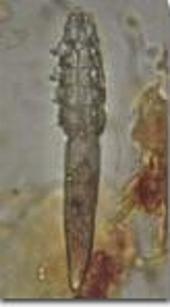
Most dogs have demodex mites, and pups acquire the mites from their mother after birth while nursing. It is NOT inherited, as it is not in the blood or the genes. It does not come from the mother's milk either. It is transmitted while nursing.
It is believed that if a pup has a weak or low immune system, the mites attack the pup's skin follicles and cause hair loss. When this happens in puppies, we are dealing with a low, weak, or poor immune system, and the demodex mites attack, just like when the human immune system is low and a person catches the common cold or flu. Demodex will normally break out around five to six months old, and as late as ten months old.
The referenced YouTube video offers a very good view of the mites in action, attacking the hair and hair follicle. Most of the other views I found just show them sitting there, moving around somewhat.
Signs & Causes: What To Look For
If your pup has a visible spot of hair loss on the back, face, under the neck, legs, feet or paws, or between the toes, you should take your pup to your veterinarian and have a skin scraping done. This will tell you if your dog needs treatment. The sooner you treat with Mitaban, Ivomectin, and anti-bacterial shampoo, or whatever your vet recommends, the less hair loss the pup will have.
Causes
- Stress or anxiety: Good stress or bad stress is believed to cause an outbreak. It is generally not life threatening if treated, and once treated it will normally never reappear. It is not contagious, and other pets in the home cannot get it. Even though humans have mites, this can rarely be transmitted to humans.
- Poor, weak, or low immune system.
- Poor nutrition.
The referenced YouTube video shows the latter stages of a dog with demodex. Some of the pictures could be disturbing to some viewers. There are also other pictures containing wildlife with demodex. Demodex is not limited to dogs and cats.
Our Boxers at Weepin Oaks

NONE OF OUR BOXERS HAVE EVER SHOWN SIGNS OR HAVE BEEN DIAGNOSED WITH DEMODEX.
Additional Comments
In addition to the information above, please be aware that whoever your breeder is, your beautiful, healthy Boxer may or may not show signs of demodex later. Your breeder has done everything possible to give you a healthy puppy and to make sure the pup has a high immune system when you take your pup home. Help your pup by making sure his or her immune system stays high.
If your puppy is diagnosed with demodex, don't be hateful or condemn the breeder. Remember: most dogs have the demodex mite. Don't let your pup's immune system go down through stress, allergies, or anything else.
Something to think about: the very few dogs that wouldn't have the demodex mite would have been born by C-section and then bottle fed. Those pups would most likely have a low immune system.
Keep The Immune System High
This is another reason why I highly recommend NuVet Plus to keep your puppy or dog's immune system high. I have NuVet Plus in my contract because of this.
Learn About NuVet Plus